
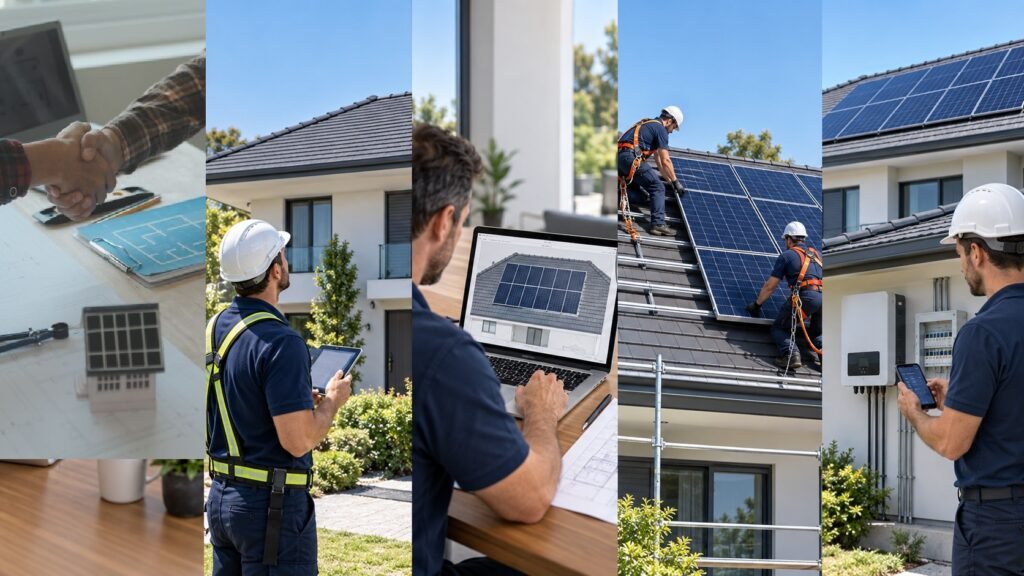
Installing a solar system is a long-term investment that must be planned carefully. A properly designed system does not start with mounting the panels, but with analyzing consumption, assessing the property and choosing the solution that fits the client’s real needs.
From the first consultation to testing and activating monitoring, every phase affects safety, performance and return on investment. Below we explain how a professional solar project is carried out from start to handover.
A quality solar system is not defined only by the panels and the inverter, but by accurate design, professional installation, electrical protection and a full check before commissioning.
1. Initial consultation and consumption analysis
The process begins with a conversation about your needs, goals and budget. Your electricity bills are analyzed, ideally for the last 12 months, to understand annual consumption and how energy is used throughout the day.
This analysis helps determine whether the system should be designed to reduce bills, increase self-consumption, provide backup power during outages, or a combination of these goals.
2. Site visit and property assessment
The technical team visits the property to check the available surface area, the orientation and pitch of the roof, shading, the condition of the structure and the options for placing the equipment.
- The space available for the solar panels is checked.
- The impact of trees, chimneys and surrounding objects is assessed.
- The structure and condition of the roof are checked.
- The positions of the inverter, batteries and protective devices are determined.
- The existing electrical installation and the connection point are analyzed.
3. Determining the system capacity
Based on consumption and the conditions of the property, the recommended system capacity is determined. The goal is not necessarily to install the maximum number of panels, but to create a system that produces energy in line with the client’s needs and consumption profile.
During this phase, the expected annual production, potential savings, approximate cost and payback period are calculated. For an initial estimate, you can also use our Solar Wizard Calculator.
4. Technical design and equipment selection
After the assessment, the technical solution for the system is prepared. The panels, inverter, mounting structure, cables, protective devices and monitoring system are selected. If energy storage or backup power is required, the project also includes a hybrid inverter and batteries.
During the design, the placement of the panels, the string configuration, the DC and AC cable routes, grounding, surge protection and the way of connecting to the existing installation are determined.
5. Quotation and project planning
The client receives a clear quotation that includes the proposed equipment, the system capacity, the included works, the warranty terms, the completion timeline and the total cost. Any change or additional work must be agreed before the installation begins.
After the quotation is approved, the equipment supply, team organization and installation date are planned.
6. Documentation and approvals
Depending on the type and capacity of the system, technical documentation, consents and grid connection procedures may be required. For systems that will feed excess energy into the grid, the requirements of the operator and the energy supplier must be met.
The Voltaris team guides clients through the process and helps prepare the necessary technical documentation.
7. Solar system installation
Installation begins with the secure placement of the mounting structure and the solar panels. Next come the DC connections, inverter installation, AC connections, grounding, protective devices and the monitoring system.
- Mounting of the structure and solar panels.
- Connection and organization of the DC cables.
- Installation of the inverter and batteries, where planned.
- Installation of DC and AC electrical protection.
- Grounding, labeling and final finishing of the installation.
The physical installation of a solar system for a home can usually be completed within one to three days. Larger or more complex projects take longer.
8. Testing and commissioning
Before activation, the system is inspected and tested to verify polarity, DC voltages, electrical connections, grounding continuity, insulation, protective devices and communication with the monitoring system.
The inverter is configured according to grid requirements and the planned operating mode. After startup, production, grid parameters, alarms and the operation of all components are checked.
9. Monitoring and system handover
After commissioning, the app or online platform for monitoring production and consumption is set up. The client receives instructions on using the system, the main equipment, safety procedures and how to check performance.
The documentation, warranty terms and maintenance information are handed over to the client once the work is completed.
10. Maintenance and long-term support
Solar systems require relatively little maintenance, but regular monitoring, cleaning according to the level of soiling, and professional inspections help maintain the safety and performance of the system.
Voltaris offers maintenance, inspection, diagnostics and technical support for photovoltaic systems, helping clients maintain optimal output and the value of their investment for many years.
Planning to install a solar system? Contact us for a professional assessment and a solution tailored to your home or business.
11. Free tool for estimating your solar system
Thinking about switching to solar energy, but don’t know where to start? Solar Wizard guides you through a quick assessment and instantly gives you a calculation tailored to your property — system capacity, annual savings and payback period.
What you get in 2 minutes:
- The recommended solar system capacity for your home or business
- The projected annual savings on your electricity bill
- The approximate system cost and payback period
- The environmental impact of your future solar installation
No obligation. No pressure to buy. Just reliable figures.
— kWh/
- —
- —
- —
- —
- —